
Security Team Declares "Screw It" after 847th Critical Vuln Turns out to be Some Obscure Library Nobody Uses


Security Team Declares "Screw It" after 847th Critical Vuln Turns out to be Some Obscure Library Nobody Uses

After the 847th “critical” vulnerability turned out to affect a library nobody’s used since 2019, Acme Corp’s security team finally snapped. The CISO declared “screw it,” shredded the compliance binder, and poured a “therapeutic amount” of whiskey — pioneering what analysts now call Vulnerability Fatigue Syndrome.
Security Team Declares "Screw It" after 847th Critical Vuln Turns out to be Some Obscure Library Nobody Uses
Security Team Declares "Screw It" after 847th Critical Vuln Turns out to be Some Obscure Library Nobody Uses
After the 847th “critical” vulnerability turned out to affect a library nobody’s used since 2019, Acme Corp’s security team finally snapped. The CISO declared “screw it,” shredded the compliance binder, and poured a “therapeutic amount” of whiskey — pioneering what analysts now call Vulnerability Fatigue Syndrome.
DENVER, CO — In a move that surprised absolutely nobody in the cybersecurity industry, Acme Corp CISO David Thompson officially declared "screw it" after discovering that CVE-2025-BOGUS, initially rated as "world-ending critical" with a CVSS score of 11.0, affects a deprecated logging library that was removed from production systems in 2019.
"I've been in this business for 20 years, and I'm done pretending that a vulnerability in some random Node.js package that converts RGB to hexadecimal is going to bring down Western civilization," Thompson announced during what witnesses described as a "beautifully unhinged" all-hands meeting.
"The attack vector requires the attacker to have root access, physical possession of the server, knowledge of ancient Sumerian, and the ability to perform complex mathematical calculations while standing on one leg during a Category 5 hurricane. But sure, let's call it critical." — David Thompson, CISO (Currently updating their LinkedIn)
The vulnerability, discovered by security researcher "xX_H4ck3r_Xx" (real name: Brad from Accounting), allegedly allows attackers to potentially maybe sort of theoretically gain unauthorized access to systems if they first compromise eighteen other systems, obtain admin credentials, and successfully guess the server's WiFi password.
Thompson's declaration comes after a particularly brutal week that saw his team scramble to patch CVE-2025-OHFFS (a critical flaw in a PowerPoint plugin), CVE-2025-SERIOUSLY (a high-severity bug in a calculator app), and CVE-2025-YOUREKIDDINGME (a medium-risk issue in a README file that would allow attackers to... make it print sad face emojis).
"We spent 40 hours in war rooms last Tuesday because some vendor's scanner flagged a library we don't even use anymore," explained Senior Security Engineer Maria Chen, who has submitted her resignation three times this month alone. "The vendor insisted it was exploitable. When we asked for proof of concept, they sent us a 47-page PDF explaining that in a very specific configuration that has never existed in nature, an attacker who already owns your entire infrastructure could use this to... checks notes... read a log file they already have access to."
The breaking point came when Thompson's team received their daily vulnerability report: 847 new "critical" findings, 99.8% of which affected testing environments, demo servers that have been offline since 2018, or systems that exist only in the fevered imaginations of vulnerability scanner marketing departments. According to sources close to the situation, Thompson spent approximately six minutes reviewing the latest batch before standing up, walking to the office printer, and feeding his entire compliance binder through the shredder while maintaining unblinking eye contact with the company's auditor.
"At this point, I'm more worried about vulnerabilities in my will to live than in our attack surface," Thompson said, pouring himself what he described as "a therapeutic amount" of whiskey at 10:47 AM on a Wednesday.
"Last month we patched 3,000 'critical' vulnerabilities. This month, we got breached through a phishing email. Funny how that works." Industry analyst Rebecca Park from Gartner confirmed this is part of a growing trend she's calling "vulnerability fatigue syndrome" or VFS. "Security teams are drowning in false positives, theoretical risks, and vendors screaming about the sky falling," Park explained. "When everything is critical, nothing is critical. These teams are spending 90% of their time chasing ghosts and 10% of their time dealing with actual threats, which is probably why the actual breach success rate keeps going up."
The situation has become so dire that Acme Corp's security team has implemented what they're calling the "Thompson Scale" for vulnerability assessment, which includes categories such as "Actually Scary," "Mildly Concerning If You Squint," "Vendor Needs To Hit Sales Quota," and "Are You Serious Right Now." CVE-2025-BOGUS firmly falls into the latter category. The vulnerability, which affects the obscure "LoggerMcLogFace" library (last commit: 2016, total downloads: 47, number of people who remember installing it: 0), requires such an absurdly specific set of preconditions that Thompson's team calculated the odds of exploitation at approximately 1 in 7.4 trillion, or "roughly the same probability as a vulnerability scanner giving us actionable intelligence."
"The attack requires the attacker to already be root, have physical access to a server in a locked data center, possess knowledge of ancient Sumerian cuneiform, and maintain perfect balance on one leg during a Category 5 hurricane," Thompson said. "At that point, why would they even need the vulnerability? They could just unplug the server and throw it in a volcano."
When reached for comment, the vendor whose scanner flagged the issue, SecureScanner McSecureFace Inc., defended their assessment. "We believe all our customers deserve to know about every possible theoretical risk, no matter how impractical," said VP of Product Marketing Chad Williamson. "Sure, the exploit requires conditions that have never occurred in recorded history, but what if they do? That's why we charge $400,000 annually for our enterprise tier." Williamson then reportedly tried to schedule a call to discuss SecureScanner's new AI-powered vulnerability prediction engine, which can forecast vulnerabilities that don't exist yet, before Thompson hung up.
As of press time, Thompson has approved a new security policy that requires all "critical" vulnerability reports to be accompanied by a working proof of concept, a notarized letter from three independent security researchers confirming the vulnerability is actually exploitable, and a $100 Starbucks gift card as compensation for the time his team will waste investigating it.
The policy has reduced incoming critical vulnerabilities by 99.7%. "I'm not saying we're ignoring security," Thompson clarified, now three whiskeys deep. "I'm saying we're ignoring security theater. There's a difference, and I'm too tired to keep pretending there isn't." When asked about his plans for addressing the remaining 0.3% of vulnerabilities that meet his new criteria, Thompson simply smiled and pointed to his laptop screen, which displayed a job posting for "CISO at literally anywhere else."
Editor's note: Since publication, Thompson has received 47 job offers, 12 speaking requests, and one marriage proposal from a security engineer who said his approach was "the sexiest thing I've ever seen."

About the Author

Joseph Barringhaus
Staff WriterSubscribe before we're patched
Like a vitamin you ingest with your eyes. The best cybersecurity parody, delivered.
Trending

French Locksmith Named Claude Launches Line of Padlocks; Cybersecurity Stocks Lose $18 Billion

Riot Breaks Out at Corporate Headquarters after Security Team Introduces “Shift Left”
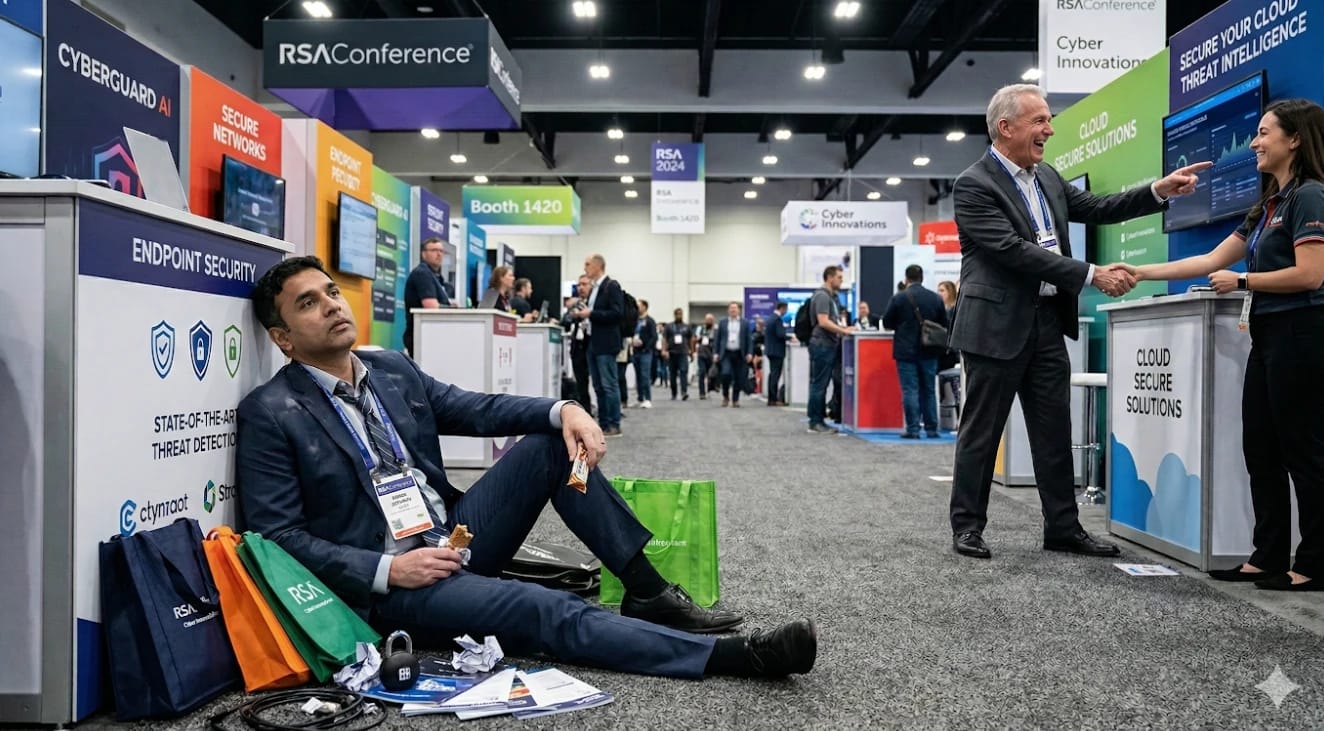
Judge Sentences CISO to 8 Consecutive Hours on RSA Expo Floor as Formal Punishment for Security Breach

Related Coverage
Trending
French Locksmith Named Claude Launches Line of Padlocks; Cybersecurity Stocks Lose $18 Billion
Riot Breaks Out at Corporate Headquarters after Security Team Introduces “Shift Left”