French Locksmith Named Claude Launches Line of Padlocks; Cybersecurity Stocks Lose $18 Billion

French Locksmith Named Claude Launches Line of Padlocks; Cybersecurity Stocks Lose $18 Billion

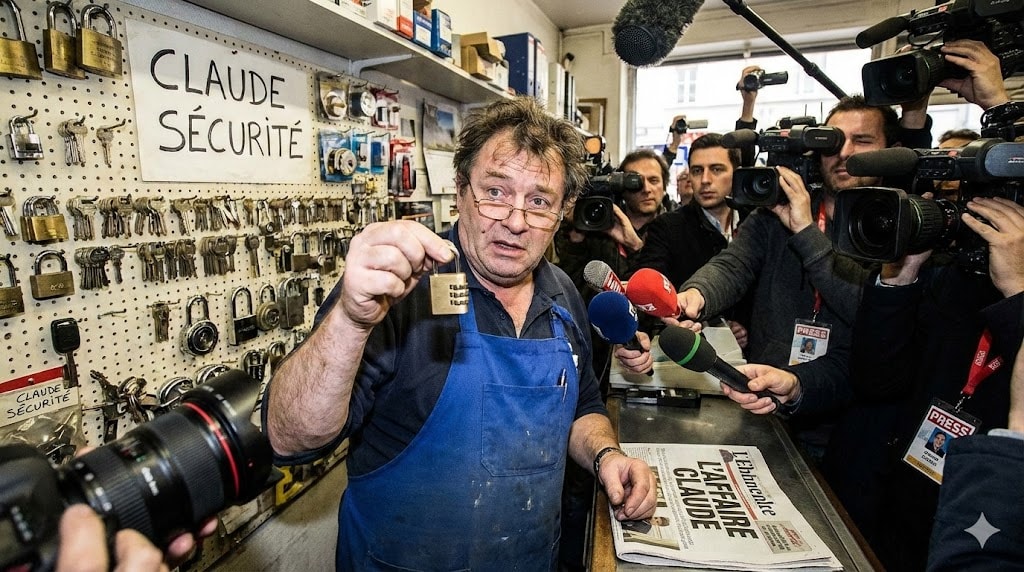
Cybersecurity stocks lost $18 billion on Tuesday after algorithmic trading systems misread a French locksmith's product launch as an AI security announcement.
French Locksmith Named Claude Launches Line of Padlocks; Cybersecurity Stocks Lose $18 Billion
French Locksmith Named Claude Launches Line of Padlocks; Cybersecurity Stocks Lose $18 Billion
Cybersecurity stocks lost $18 billion on Tuesday after algorithmic trading systems misread a French locksmith's product launch as an AI security announcement.
Lyon, France — Cybersecurity stocks plunged across the board on Tuesday after Claude Fontaine, a 54-year-old locksmith from Lyon, France, launched a line of combination padlocks under the brand name "Claude Security." The Nasdaq Cybersecurity Index fell 7.2% within minutes of the announcement appearing on a French trade publication's website.
The selloff was initiated by algorithmic trading systems that flagged the headline "Claude Launches New Security Product" and cross-referenced it against existing positions in CrowdStrike, Palo Alto Networks, Okta, Zscaler, Cloudflare, and SailPoint. All six stocks were in freefall before a single human being had read past the headline.
"Our NLP models are trained to detect competitive threat signals," said a spokesperson for QuantVault Capital, the quantitative hedge fund whose systems fired first. "The combination of 'Claude' and 'security' and 'launch' triggered our cybersecurity disruption playbook. The system worked exactly as designed. The fact that the product is a physical padlock is, frankly, not our problem."
By the time equity analysts arrived at their desks, CrowdStrike was already down 6% and trending on Bloomberg Terminal chat. Rather than investigate the source of the selloff, several analysts published hastily written notes justifying it. Ridgemont Partners issued a two-page downgrade note titled "Claude Security: Assessing the Threat," which described the product as "an AI-native approach to physical access control with potential applications across the cybersecurity stack." The note did not mention that the product retails for €11.99 at Decathlon.
"I'll be honest, I didn't click through to the article," said one analyst at a boutique research firm who had issued a sector-wide Underweight by 10:15 a.m. "I saw 'Claude' and 'security' and my muscle memory kicked in. After last week, everyone in this building is conditioned to sell cyber the moment Claude does anything. We're basically Pavlov's dogs with Bloomberg terminals."
The confusion was compounded by the fact that no analyst could confidently explain why a padlock — or for that matter, a code scanning tool — would threaten an endpoint detection company, an identity provider, a cloud firewall vendor, and a secure access company simultaneously. When pressed on the distinction between these categories, one analyst described the cybersecurity market as "basically one big security thing, but in segments."

Fontaine, who has been a locksmith for twenty-six years and speaks limited English, was baffled by the attention. "My wife called me at lunch and said I am on American television," he told reporters through a translator. "I do not know what a CrowdStrike is. I make padlocks. Very good ones — hardened steel shackle, four-digit combination. I also do a bike lock."
The CEO of the market's leading endpoint detection vendor responded to the selloff with a LinkedIn post that simply read: "It's a padlock." The post received 14,000 reactions, most of them the crying-laughing emoji, though this did not prevent a further 2% decline in after-hours trading after an analyst at Greystone Capital noted that "Claude Security's physical access control capabilities could signal a broader convergence between physical and cyber threat management."
By market close, the Global X Cybersecurity ETF had hit its lowest level in months. Whitmore Research issued a note calling the selloff "incongruent," which several portfolio managers described as "the understatement of the decade." Ashford & Keene called the rotation "indiscriminate," and one analyst noted privately that "we have officially reached the point where a locksmith in Lyon can crash the American cybersecurity market by selling padlocks."
At press time, Fontaine had been contacted by three Silicon Valley venture capital firms, two of which offered term sheets despite the language barrier. When asked if he planned to expand into the cybersecurity market, he replied through a translator: "I don't know what that is. But I am working on a very nice deadbolt."
About the Author

Harry Wetherald
Staff WriterHarry Wetherald is the CEO and Co-Founder of Maze.
Subscribe before we're patched
Like a vitamin you ingest with your eyes. The best cybersecurity parody, delivered.