
Security Sales Guy Finally Understands What His Network Detection Tool Does


Security Sales Guy Finally Understands What His Network Detection Tool Does

In a company milestone, top-performing sales director Marcus Pemberton finally understands the network detection tool he's been selling for two and a half years. The revelation occurred during demo 305, when Pemberton moved beyond his signature pitch about "using AI to detect the bad guys" and actually explained what deep packet inspection means. His solutions engineers, who've spent countless days providing last-minute damage control, are calling it "encouraging but potentially dangerous.
Security Sales Guy Finally Understands What His Network Detection Tool Does
Security Sales Guy Finally Understands What His Network Detection Tool Does
In a company milestone, top-performing sales director Marcus Pemberton finally understands the network detection tool he's been selling for two and a half years. The revelation occurred during demo 305, when Pemberton moved beyond his signature pitch about "using AI to detect the bad guys" and actually explained what deep packet inspection means. His solutions engineers, who've spent countless days providing last-minute damage control, are calling it "encouraging but potentially dangerous.
Breakthrough occurs during demo 3,247 for mid-sized healthcare provider.
PALO ALTO, CA — In what company executives are calling "a significant milestone," ThreatGuard Solutions sales director Marcus Pemberton has finally grasped the fundamental functionality of the network detection and response platform he's been selling for the past two and a half years.
The breakthrough occurred Tuesday morning during a product demonstration for Riverside Medical Group, when Pemberton successfully explained that the platform analyzes network traffic patterns rather than simply "using AI to detect the bad guys" — his standard pitch since joining the company in March 2022.
"It was around slide 14 when it just clicked," said Pemberton, 34, who has closed $8.3 million in ThreatGuard licenses despite previously believing the product worked through what he described as "sophisticated algorithmic cloud stuff." "I suddenly realized we're doing deep packet inspection and behavioral analysis, not just running some magic algorithm that finds hackers. Holy shit, we're literally parsing network telemetry."
The revelation came as a surprise to ThreatGuard's technical team, who have spent the past months providing last-minute support on Pemberton's sales calls after he would promise features the product doesn't have or describe its core functionality as "basically like antivirus but for networks, but also not really."
"Marcus once told a Fortune 500 CISO that our platform 'stops hackers before they even think about attacking' by using 'predictive quantum security matrices,'" said Senior Solutions Engineer Jennifer Park, who has been muted on exactly 247 of Pemberton's demo calls. "We had to hire an additional SE just to follow him around and translate."
According to sources within ThreatGuard, Pemberton's understanding of the product had been described internally as "enthusiastically abstract." His demo decks reportedly contained 73 slides of stock photos showing hooded figures typing on laptops, interspersed with vague statements about "next-generation threat visibility" and one slide that simply read "AI AI AI AI AI" in 72-point font.
The company's technical documentation team maintains a private Slack channel called #marcus-said-what, which has archived such greatest hits as his description of network segmentation as "making different parts of the internet not talk to each other" and his assertion that their platform's integration capabilities meant it "works with all the other security things you probably have."
"For the first hundred or so demos, I was basically just reading the slides and nodding confidently when people asked technical questions before turning it over to the SEs," Pemberton admitted. "But then this morning, something Jenny said about east-west traffic inspection just made sense. I finally understand why we need that sensor deployed at the network core. We're not just, like, vibing with the packets — we're actually analyzing them."

ThreatGuard CEO Richard Holloway praised Pemberton's achievement in a company-wide email, calling it "a testament to our commitment to sales enablement and continuous learning."
"Marcus has been our top performer despite this minor knowledge gap," Holloway wrote. "Now that he understands what we actually do, there's no telling how much more we can grow. Although his close rate was already at 67%, so honestly this might not change much."
The technical team's response was more muted. Solutions Engineer Park noted that while Pemberton's newfound comprehension is "encouraging," she remains concerned about his recent enthusiasm for explaining technical details he's just learned.
"He spent 20 minutes this afternoon trying to explain TCP handshakes to our VP of Engineering," Park said. "He also keeps using the phrase 'egress filtering' in every sentence now, regardless of context. Yesterday he said we should 'egress filter' the cafeteria to improve lunch quality."
Industry analysts suggest Pemberton's learning curve, while unusually steep, is not unprecedented in the cybersecurity sector, where the average enterprise security product requires approximately 47 acronyms and six months of training to properly explain, but only 90 minutes of training to sell.
"The beauty of cybersecurity sales is that buyers are often as confused as the sellers," said Gartner analyst Rebecca Morrison. "Everyone's just nodding along hoping someone else in the room understands what's happening. Sometimes the sale closes before anyone figures out what the product does."
At press time, Pemberton was reportedly scheduling a demo with his own IT department to "finally understand what we're running internally," while simultaneously being promoted to VP of Sales for his "demonstrated commitment to product knowledge and consistent overperformance."
Update: ThreatGuard's marketing team has asked Pemberton to please stop explaining how the product actually works in his social media posts, as it's "creating confusion with our established messaging strategy of aspirational ambiguity."
About the Author

Phil O'Hagan
Staff WriterSubscribe before we're patched
Like a vitamin you ingest with your eyes. The best cybersecurity parody, delivered.
Trending

French Locksmith Named Claude Launches Line of Padlocks; Cybersecurity Stocks Lose $18 Billion

Riot Breaks Out at Corporate Headquarters after Security Team Introduces “Shift Left”
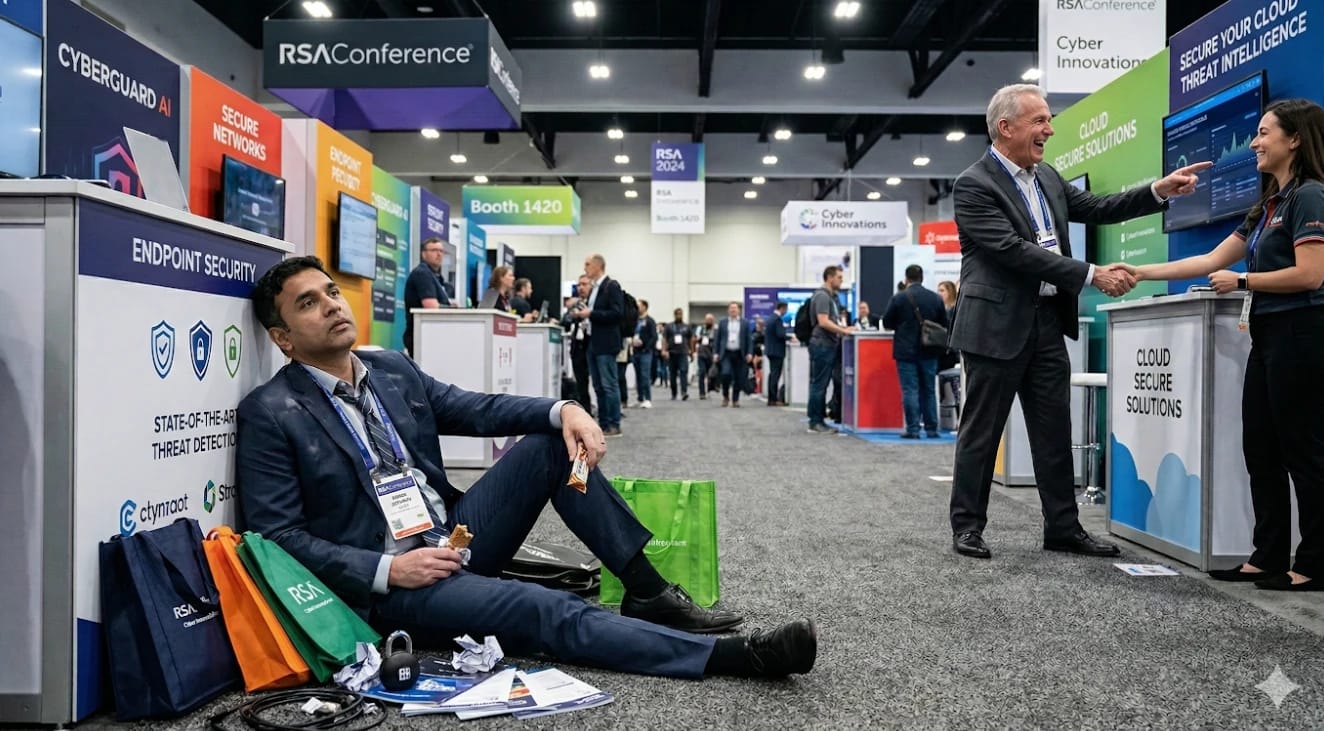
Judge Sentences CISO to 8 Consecutive Hours on RSA Expo Floor as Formal Punishment for Security Breach

Related Coverage
Trending
French Locksmith Named Claude Launches Line of Padlocks; Cybersecurity Stocks Lose $18 Billion
Riot Breaks Out at Corporate Headquarters after Security Team Introduces “Shift Left”