
Idaho potato farm Spud Industries (SI) raises $400 million after Trump executive order rebrands AI to SI

Idaho potato farm Spud Industries (SI) raises $400 million after Trump executive order rebrands AI to SI

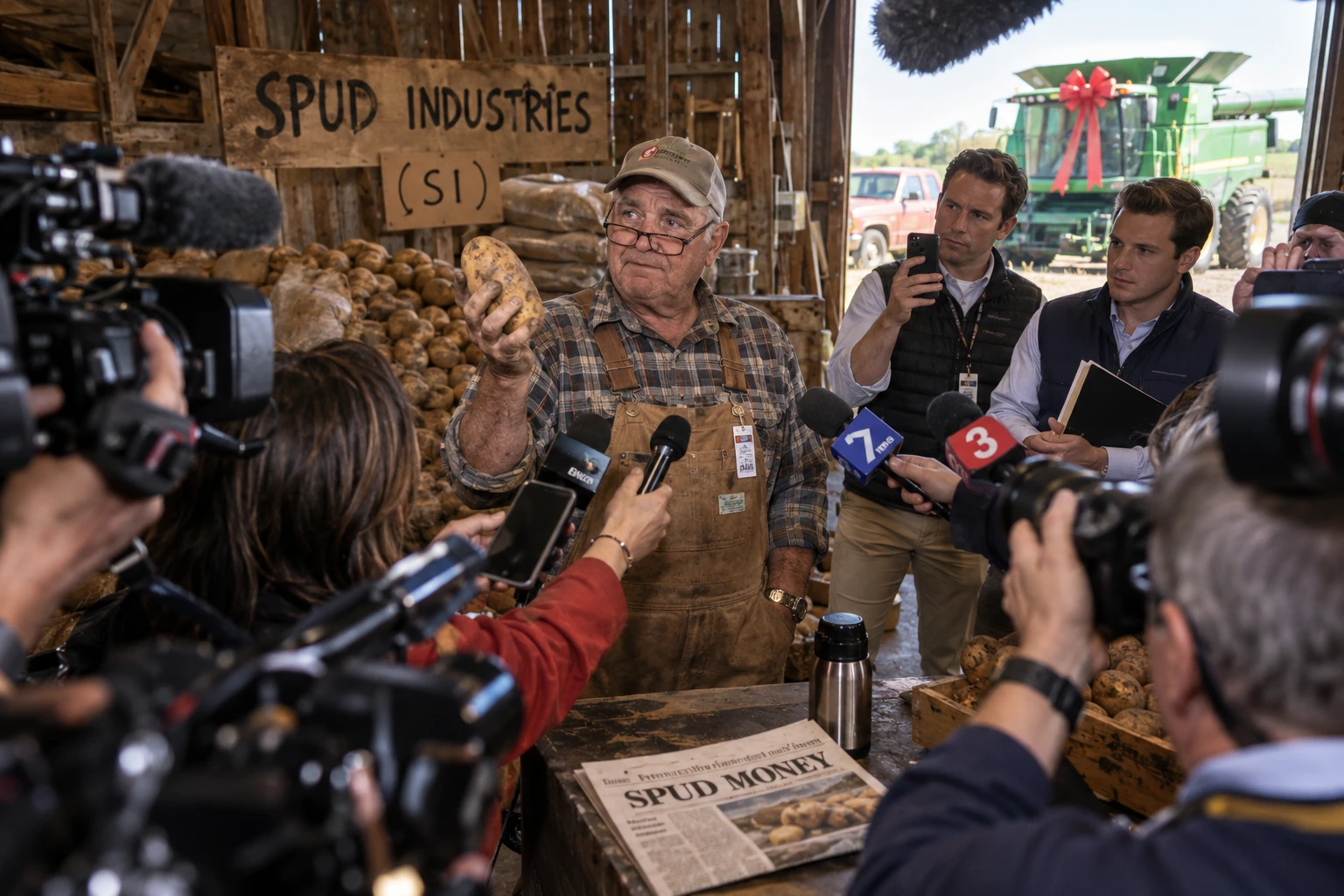
Tech investors poured $400 million into a family potato farm after Tuesday's executive order renamed Artificial Intelligence (AI) to Super Intelligence (SI).
Idaho potato farm Spud Industries (SI) raises $400 million after Trump executive order rebrands AI to SI
Idaho potato farm Spud Industries (SI) raises $400 million after Trump executive order rebrands AI to SI
Tech investors poured $400 million into a family potato farm after Tuesday's executive order renamed Artificial Intelligence (AI) to Super Intelligence (SI).
SHELLEY, Idaho. Spud Industries, a family-owned potato farm in southeastern Idaho, closed a $400 million Series A on Wednesday, less than a day after an executive order required every federal agency to stop saying "artificial intelligence" and start saying "Super Intelligence," or SI.
The round started at 3:12 a.m., when a deal-sourcing agent at Arcwell Capital ran an overnight search for "SI companies with existing federal relationships." It returned one result. Spud Industries has sold russets to the federal school lunch program since 1974, which the agent scored as "a decades-long government contract with zero churn." Arcwell had a term sheet out by 6 a.m., and two rival firms countered before a single partner had looked up what a russet was.
"Our sourcing agent is trained to find SI companies with federal traction, and it found one," said an Arcwell spokesperson. "The system worked exactly as designed. The fact that the company grows potatoes is a go-to-market detail."
Rather than question the result, Arcwell's partners spent the morning justifying it. The firm's investment memo, titled "Spud Industries and the Future of Federal SI," described the company as "a vertically integrated SI platform with deep roots in the public sector." The memo did not mention that the company's flagship product sells for $4.99 a bag at Albertsons.
"Every company in our pipeline became SI on Tuesday afternoon," said Arcwell managing partner Brent Kessler. "Spud Industries has somehow been SI-native since 1958. Their cold storage building has also held a steady 45 degrees for decades without a single outage, which is more than I can say for us-east-1."
Arcwell's technical diligence took under an hour and consisted of one associate confirming that the farm's website loaded. When Arcwell's counsel asked for a SOC 2 report, the farm sent its most recent USDA grade inspection, which counsel accepted as "functionally equivalent." The inspection rated the crop U.S. No. 1, which Arcwell's press release described as "a top-tier compliance posture."
"I didn't read the memo," said a partner at one of the firms that countered. "I saw 'SI' and 'federal' in the same sentence and signed. After Tuesday, nobody in this building wants to be the partner who passed on SI."
Dale Lindqvist, who runs the farm with his brother, learned about the round from a phone call at five in the morning. "The man asked about our compute," Lindqvist said.

"I do not know what compute is. I grow potatoes. Very good ones, U.S. No. 1, mostly russets, and we also do a Yukon Gold. He said our cold storage building was perfect for GPUs, and then he wired the money."
By Wednesday afternoon, Arcwell's portfolio services team had rewritten spudindustries.com. The homepage, which used to list bag sizes and a phone number for the loading dock, now describes the company as "an SI-native platform delivering russet intelligence at the edge." A new pricing page lists the fifty-pound bag as "Enterprise."
Arcwell also moved three sales reps from a portfolio company that shut down onto the Spud Industries payroll. By Thursday, one of them had booked thirty minutes with the CISO of a federal agency to "discuss SI-driven outcomes for your security program."
"It was a kid named Travis asking if we wanted to order potatoes for the cafeteria," the CISO said. "He pointed out that the executive order requires us to use SI, and technically he's not wrong. He knew what he was selling, he knew his pricing, and he never once said 'single pane of glass.' It was the best vendor meeting I've had all year."
Lindqvist says the farm has no plans to change what it does. "They keep asking about our roadmap," he said. "The roadmap is we plant in April and dig in September, and it's been the same roadmap for three generations."
At press time, a separate $1.2 billion term sheet had been sent to Staten Island, which now describes itself as the world's first SI-native borough.
About the Author

Anonymous
Guest ContributorSubscribe before we're patched
Like a vitamin you ingest with your eyes. The best cybersecurity parody, delivered.
Trending
French Locksmith Named Claude Launches Line of Padlocks; Cybersecurity Stocks Lose $18 Billion
Judge Sentences CISO to 8 Consecutive Hours on RSA Expo Floor as Formal Punishment for Security Breach

Riot Breaks Out at Corporate Headquarters after Security Team Introduces “Shift Left”
Related Coverage
Trending
French Locksmith Named Claude Launches Line of Padlocks; Cybersecurity Stocks Lose $18 Billion
Judge Sentences CISO to 8 Consecutive Hours on RSA Expo Floor as Formal Punishment for Security Breach