AWS Insists Outage "Definitely Not DNS" Before Admitting It Was Totally DNS
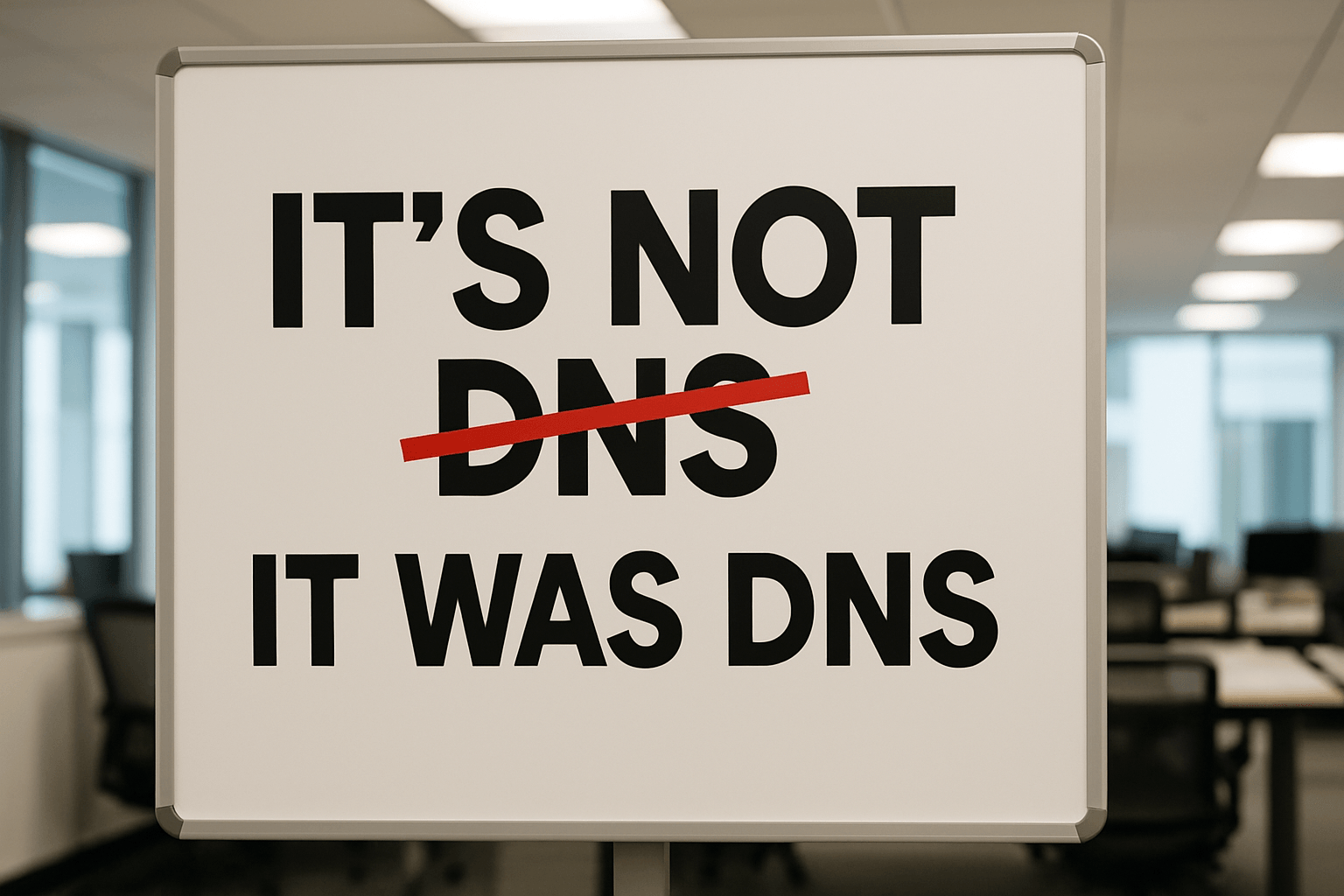

AWS Insists Outage "Definitely Not DNS" Before Admitting It Was Totally DNS

Amazon spends 8 hours ruling out DNS before discovering root cause was DNS, proving it's always DNS even when they swear it isn't.
AWS Insists Outage "Definitely Not DNS" Before Admitting It Was Totally DNS
AWS Insists Outage "Definitely Not DNS" Before Admitting It Was Totally DNS
Amazon spends 8 hours ruling out DNS before discovering root cause was DNS, proving it's always DNS even when they swear it isn't.
NORTHERN VIRGINIA - Following last week's massive AWS outage that affected thousands of companies, Amazon Web Services has sheepishly admitted that the root cause was DNS, despite spending eight hours publicly insisting it was "definitely, absolutely, 100% not DNS."
"We want to assure customers that this outage was caused by a sophisticated cascading failure in our Route 53 service," read AWS's initial status page update. "It is absolutely not a DNS issue. We've checked DNS. DNS is fine. Look elsewhere." The protests continued for several hours, with AWS engineers repeatedly stating that they had "ruled out DNS," "verified DNS is functioning correctly," and "seriously, stop asking about DNS" in increasingly defensive status updates.
"Around hour six, I started getting suspicious," noted DevOps engineer Jamie Rodriguez, whose company lost $400,000 during the outage. "They were protesting about DNS way too much. It's like when someone says 'I'm definitely not lying' - you know they're lying."

Internal sources report that AWS's incident response team spent the first four hours investigating every possible cause except DNS, including theoretical quantum fluctuations, sunspot activity, and whether someone had accidentally unplugged US-EAST-1. "We checked the power cables, the network switches, the cooling systems," explained one AWS engineer who requested anonymity. "We even briefly considered that aliens might be involved. But DNS? Come on, we're professionals. We would have checked DNS first."
The breakthrough came when a junior engineer, fresh out of college, timidly suggested during hour seven that "maybe we should check DNS again, just to be sure." Senior engineers reportedly laughed for three minutes before reluctantly running a DNS diagnostic, at which point they discovered that yes, it was DNS, it had always been DNS, and it would probably always be DNS.
"The issue was a misconfigured DNS resolver that created a cascading failure across our Route 53 infrastructure," read AWS's revised post-mortem, posted at 4 AM after someone presumably threw a laptop across the room. "In retrospect, we should have checked DNS." The DNS issue was so fundamental that one security researcher described it as "the equivalent of spending eight hours trying to figure out why your car won't start before realizing you're out of gas."
Network engineers across the internet responded to the news with a collective "told you so," with many pointing out that the ancient sysadmin proverb "it's always DNS" has never once been proven wrong in the history of computing. "There are only two types of outages," explained veteran infrastructure engineer Patricia Wong. "Outages where you immediately check DNS and fix it in five minutes, and outages where you waste eight hours checking everything else before checking DNS and then fixing it in five minutes."
AWS has promised to update their incident response procedures to include "actually check DNS first" as step one, replacing the current procedure which apparently listed DNS as step 47, right after "consider interdimensional interference." The cloud provider has also announced plans to create a new premium service called "Route 53 But We Promise We Actually Checked DNS This Time" for customers willing to pay an additional 30% monthly fee.
"We're implementing new monitoring systems, enhanced redundancy, and a giant sign in the NOC that says 'CHECK DNS FIRST YOU IDIOTS,'" AWS's CTO announced during an apology call with enterprise customers. "We are committed to learning from this incident and definitely checking DNS earlier next time."
Industry analysts predict that AWS will check DNS first during their next outage, which they estimate will occur in approximately three to six months, because it's always DNS, and it will always happen again. At press time, a small fire in the US-EAST-1 data center was being investigated, with AWS engineers adamantly insisting it was "definitely not DNS" despite the fire alarm being named "dns-alarm-01."
About the Author

The Exploit Staff
Staff WriterThe editorial team at The Exploit - bringing you the most absurd cybersecurity news before it's patched.
Subscribe before we're patched
Like a vitamin you ingest with your eyes. The best cybersecurity parody, delivered.
Trending

French Locksmith Named Claude Launches Line of Padlocks; Cybersecurity Stocks Lose $18 Billion

Riot Breaks Out at Corporate Headquarters after Security Team Introduces “Shift Left”

Judge Sentences CISO to 8 Consecutive Hours on RSA Expo Floor as Formal Punishment for Security Breach

Related Coverage
Trending
French Locksmith Named Claude Launches Line of Padlocks; Cybersecurity Stocks Lose $18 Billion
Riot Breaks Out at Corporate Headquarters after Security Team Introduces “Shift Left”